
Where Fountain Valley City Directories Survive
Fountain Valley city directories are a regional research problem. Orange County Public Libraries offers genealogy databases and reference help, while UC Irvine's Orange County Regional History Collection preserves a documented group of regional volumes. A title can carry Orange County, Santa Ana, Central Orange County, South Coast Area, South Orange County, or Saddleback Valley rather than Fountain Valley. The reviewed sources do not verify a complete Fountain Valley-only run, a publisher, or a year-by-year shelf list. That gap matters. A regional title is a lead, not proof that a particular house or person appears. Check the title page, locality list, and volume key before treating a result as evidence.
| Collection | Years | Publisher or title status | Where Held | Access |
|---|---|---|---|---|
| Orange County regional directories | Exact Fountain Valley run unverified | Publisher not verified in reviewed sources | OCPL catalog and reference service | Ask staff to confirm each volume |
| Orange County directories | 1963-1965 | Title-page and publisher check required | UCI MS.R.121 | Advance contact; restrictions may apply |
| Santa Ana and Central Orange County directories | 1952 and 1962 | Title-page and publisher check required | UCI MS.R.121 | Inspect locality coverage in person |
| South Coast Area directories | 1969-1970 | Title-page and publisher check required | UCI MS.R.121 | Advance contact before research |
| South Orange County directories | 1969-1980 | Title-page and publisher check required | UCI MS.R.121 | Regional title; Fountain Valley not presumed |
| Saddleback Valley directories | 1979-1980 | Title-page and publisher check required | UCI MS.R.121 | Regional context; inspect the volume |
| Federal population census | Public through 1950 | Federal census schedules | NARA and library genealogy databases | Released under the 72-year rule |
The verified rows show where a search can begin, not a guaranteed Fountain Valley city directory census. No reviewed source confirms a Polk volume or a Fountain Valley-specific publisher and year run, so neither should be presented as fact. Search catalog headings broadly, then record the exact geographic title, edition, publisher line, and page where a locality appears. If a volume is unprocessed, restricted, or absent from a web catalog, reference staff can still confirm whether a shelf, microfilm copy, or related newspaper file is available. A careful record of what was checked keeps a negative result meaningful.
The California State Archives catalog and research-service page is a useful state-level fallback when a local title is described but is not available through an open web viewer.
The Archives route is a finding aid and research service, not evidence that a particular Fountain Valley directory is digitized. Ask for the record group and access terms before relying on a catalog description.
Fountain Valley City Directory Year Runs
UC Irvine's Orange County Regional History Collection, identified as MS.R.121 in the Online Archive of California, is the clearest verified directory lead. The collection spans 1950-1990, but its finding aid names separate regional runs rather than a single citywide series. Orange County appears for 1963-1965. Santa Ana and Central Orange County appear for 1952 and 1962. South Coast Area appears for 1969-1970, South Orange County for 1969-1980, and Saddleback Valley for 1979-1980. Those dates are useful search targets. They do not prove that every Fountain Valley street or every year is inside each book.
Regional labels also reflect the way the county grew. Fountain Valley incorporated in 1957, and earlier references may use Talbert, an unincorporated Orange County description, or another nearby community heading. Even after incorporation, a publisher may have canvassed a wider service area. Compare a directory's locality list with the address, tract, and year being researched. If an entry is absent, record the edition and section checked instead of converting the absence into a claim that the household had not yet arrived.
The UCI finding aid for the Orange County Regional History Collection supplies the verified run names and dates, while its collection notes call for advance contact and warn that an unprocessed collection may have restrictions.
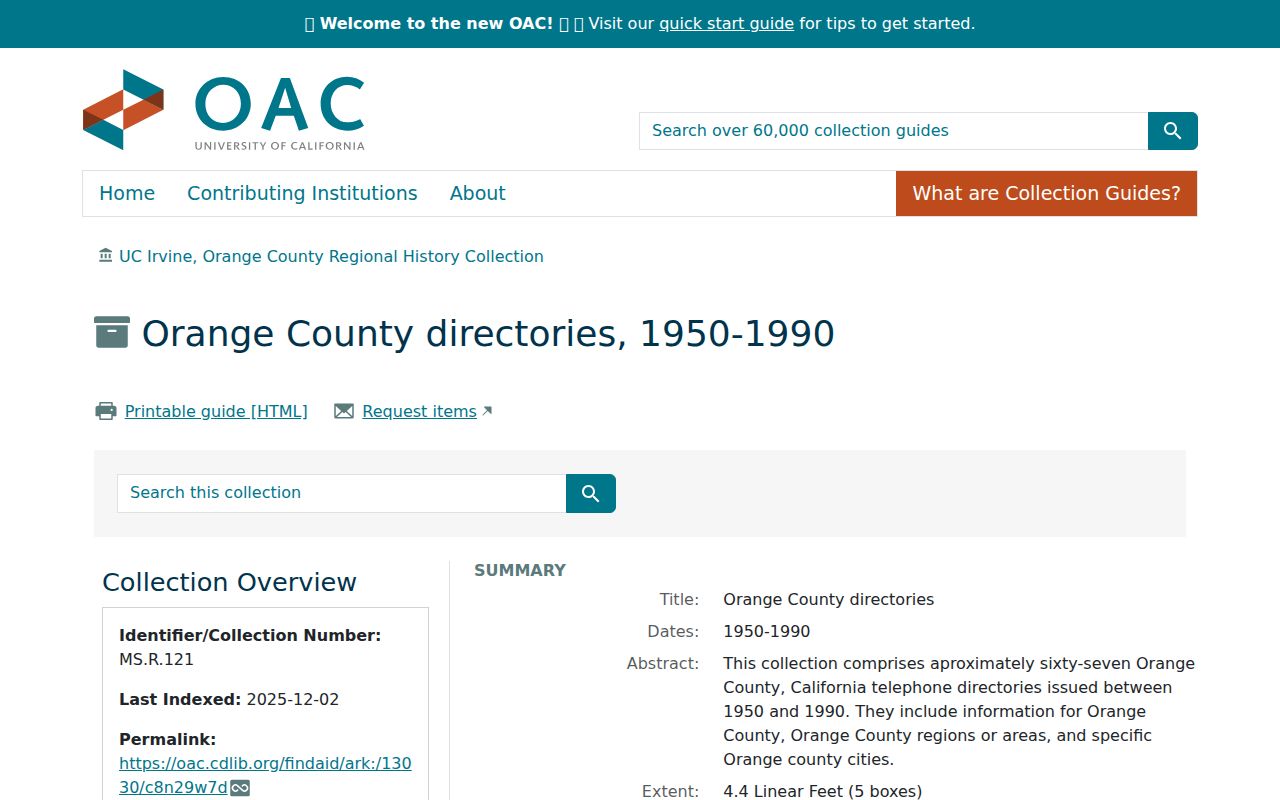
The image represents the archival lead, not a digitized Fountain Valley entry. The next check is the physical volume's title page, abbreviation key, and locality coverage.
Fountain Valley City Directory Shelf at OCPL
Fountain Valley Library is an Orange County Public Libraries branch at 17635 Los Alamos Street. The reliable path is to ask reference staff for the catalog record and for related Orange County telephone directories, city or suburban directories, reverse and criss-cross volumes, newspaper databases, yearbooks, obituary tools, and local-history vertical files. The OCPL genealogy eLibrary is the entry point for licensed family-history resources. Remote access and library-card rules vary by database, so a result visible from home may not have the same features as an in-branch session.
Ancestry Library Edition requires a full-privileges OCPL card and in-branch use. HeritageQuest adds census, local and family-history, and mapping material. Fold3 adds military records and personal documents. These tools can fill a gap when an open search does not expose a directory index. They do not remove the need to read the volume's own key or confirm whether a regional title includes Fountain Valley.
The Fountain Valley branch page records a local library history that is useful context for a shelf search: the branch opened January 23, 1965, moved and reopened in 1991, and the newer building is described as resembling a seahorse from above.
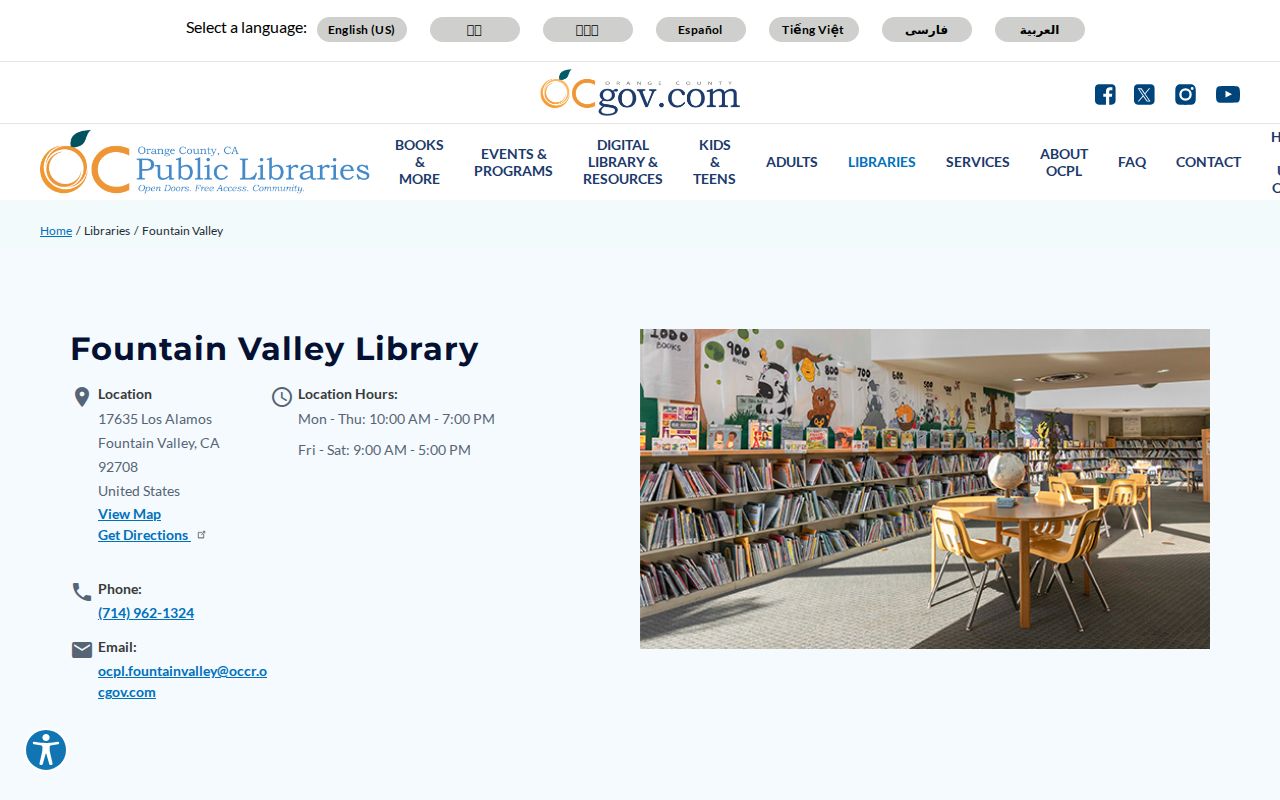
The branch image points to the reference setting where catalog and database questions can be narrowed. It does not establish an exact year run, which remains a staff-confirmation task.
Reading Fountain Valley City Directory Entries
A typical regional city directory entry puts the surname first, followed by a given name or initial. A spouse may appear in parentheses, and “wid” can identify a widow or widower of the named spouse. Occupation and employer information may follow, then a home marker and street address. In one volume, “h” may mark home and “r” may mean resides or rooms, but the meaning depends on that publisher's key. Treat these marks as historical notation, not as a current ownership or occupancy record.
| Entry field | What the volume may show |
|---|---|
| Name | Surname first, then given name or initial; spouse may appear in parentheses. |
| Family clue | “Wid” can identify a widow or widower of the named spouse. |
| Occupation or employer | May follow the name and can help distinguish two people with similar names. |
| Home marker and address | “h” may mark home; the street and house number supply the address lead. |
| Residence mark | “r” can mean resides or rooms depending on the volume; read the local key. |
- Criss-cross directory
- A reverse section that reorders entries by street and house number, allowing an address-to-listed-occupant search.
- Householder index
- A name-first listing centered on the adult recorded as the household head; volume conventions can differ.
- Abbreviation key
- The publisher's legend for marks such as “h,” “r,” and “wid.” Read it before interpreting an entry.
The sample fields show why a directory is valuable for family history but limited as proof of a present-day resident. Listed adults, spouses, addresses, and dated clues can be compared with a deed, a census page, a newspaper item, or a probate file. An absent name may reflect canvassing limits, an unlisted phone, recent construction, an address boundary, or an edition gap.
Criss-Cross Paths Through Fountain Valley City Directories
Alphabetical pages answer a person-to-address question. Reverse or criss-cross pages answer an address-to-listed-person question. Start with the house number and street as printed, then test spelling, nearby ranges, and the volume's abbreviation key. A reverse section may be absent from a title, and the research file does not verify an exact Fountain Valley criss-cross run. That is why the title page and contents matter as much as the search term.
For a modern parcel question, the Fountain Valley street directory uses a different, address-keyed record chain. A historical reverse entry should instead be dated to its edition and described as a listed occupant clue. Compare the address with tract or lot information when possible, because a regional book can use older community headings while the parcel now carries a Fountain Valley label.
Note: A missing name can reflect a directory's canvassing method, unlisted phone status, boundary choice, recent construction, or a gap between editions.
From 597 Residents to 31,826
Fountain Valley's growth gives the regional shelf a useful numerical frame. The research records 597 residents at the city's 1957 incorporation and 31,826 by 1970. That change helps explain why a searcher's best volume may be organized around a wider Orange County area instead of a mature city-only series. More residents, new tracts, and changing place labels create more chances for a name to move between county, suburban, and city headings.
The numbers are context, not a substitute for a directory entry. A household still needs a dated page, a printed address, or a second record that anchors it. Use the growth story to widen the catalog search to Orange County, Santa Ana, Central Orange County, South Coast Area, South Orange County, and Saddleback Valley. Then narrow the result with the address, spouse, street, or other clue that can be checked in another source.
Fountain Valley City Directory and Census Pairing
Federal population census schedules are public through 1950 under the 72-year rule. The National Archives and Records Administration and library genealogy databases can supply household names, ages, relationships, birthplaces, occupations, and address or location details for released schedules. A 1952 regional directory can be compared with the 1950 census as a near-year check, but two years are not the same snapshot. Families move, children grow, and a directory's canvass may use a different boundary.
The National Archives census research page explains the public-release framework and provides a dependable access route for the released federal schedules.
The census image belongs beside, not inside, the directory evidence. Record the enumeration geography and household relationships, then note every difference instead of forcing the two records to agree.
Trace Fountain Valley City Directories Across Years
A household trail works best when each edition adds a small, dated fact. Begin with a known person, address, or year. The goal is not to create a timeless list. It is to show how a name and place connect across records while leaving uncertainty visible.
- Choose a known year and address, then copy the surname, given name, spouse notation, and house number exactly as printed.
- Read the alphabetical section and the street or reverse section when the volume has both. Photograph or transcribe the abbreviation key first.
- Move one edition at a time. Record a new street, spouse, occupation, “wid” notation, or residence mark without treating it as proof of ownership.
- Pair a directory year with the nearest released census, especially the 1940 or 1950 schedule, and compare household relationships, age, and enumeration geography.
- When the name disappears, check newspaper archives, obituary material, vital-record rules, probate files, and later directory editions before deciding whether the person moved or died.
Fountain Valley's 1957 incorporation is a key checkpoint. Earlier residents may be filed under Talbert or broader Orange County geography, so a search limited to the modern city name can miss them. Later absences remain ambiguous. A directory may omit a household because of its canvass, phone-listing practice, boundary, or publication gap. Use a dated cross-check before closing the trail.
When a Fountain Valley Directory Goes Quiet
A silent year calls for a fallback chain, not a guessed publisher. OCPL newspaper databases and local microfilm can supply obituaries, marriages, moves, clubs, and legal notices. The county Clerk-Recorder handles official copies and vital-record services, while the California Department of Public Health maintains statewide vital records under record-specific access rules. Historical indexes are collection-specific, and confidential marriages, adoption files, and specified amendments do not open like ordinary public records.
The Orange County Clerk-Recorder service inventory is the county starting point for recorded documents and vital-record routes. A search result or index is not the same as a certified copy. Check eligibility, the event type, and the custodian before ordering. If the question concerns an heir, a public probate filing may bridge a death record to a later deed, but the filing must be available and the relationship should be corroborated.
The Orange County Archives is a documented in-person fallback at Old Orange County Courthouse Room 108, 211 W. Santa Ana Boulevard, Santa Ana. Its published holdings include historical property documents, vital records, Orange County directories, newspapers and magazines, photographs, and affiliated-agency records. Published weekday hours are 9 a.m. to noon and 1 p.m. to 4:30 p.m.; verify before travel.
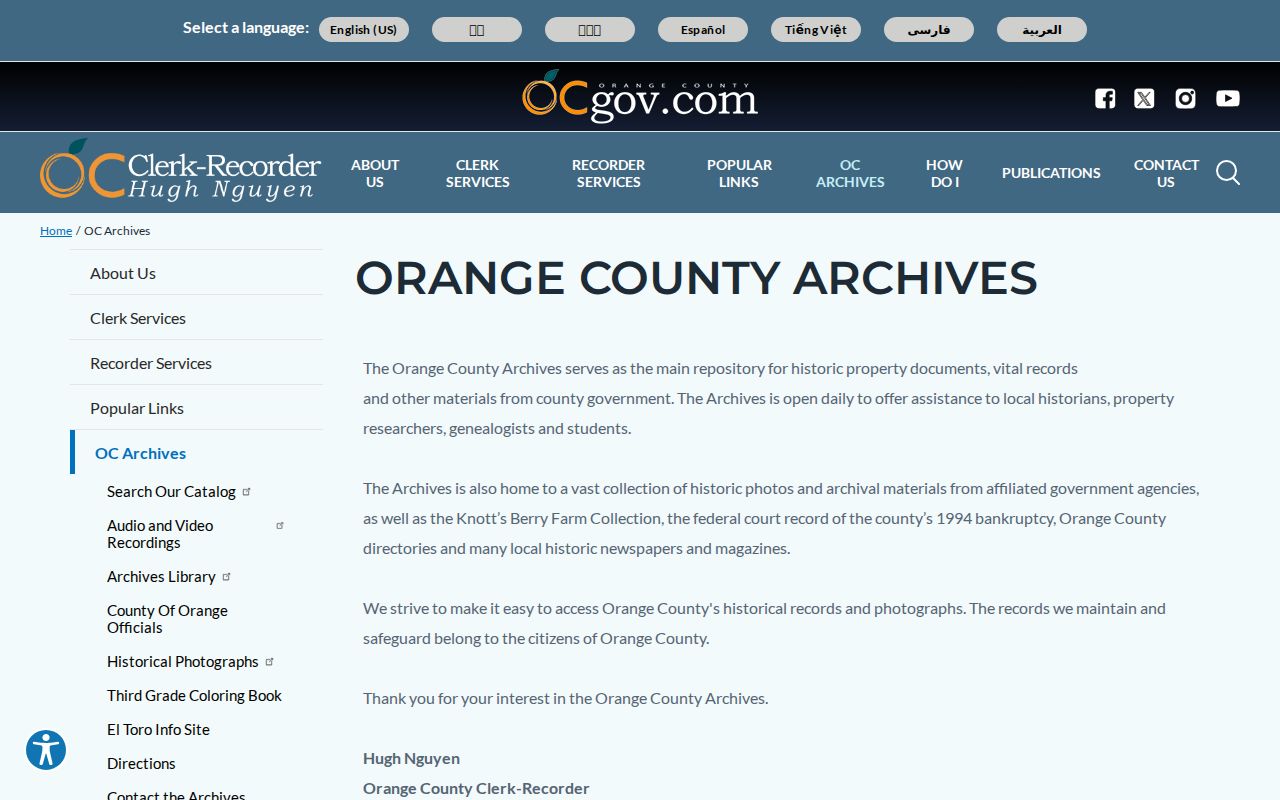
The Archives image marks a physical research path when web catalogs stop. It does not fill the documented gap about an exact Fountain Valley publisher or year-by-year run.
Fountain Valley City Directory Timeline
Place names and collection dates make the search easier to audit. The timeline below separates jurisdiction history from verified directory runs. It deliberately leaves the first and last Fountain Valley-specific publication unclaimed because the reviewed sources do not establish them.
| Year or span | Research event | Why it matters |
|---|---|---|
| 1889 | Orange County formed from Los Angeles County | Older land and court trails may use the earlier county jurisdiction. |
| 1899 | First local post office opened as Talbert | Pre-incorporation place-name searches should include Talbert. |
| June 13, 1957 | Fountain Valley incorporated | City records begin later than county-held records. |
| 1952 and 1962 | Santa Ana and Central Orange County runs verified at UCI | Early regional leads require locality checking. |
| 1963-1965 | Orange County run verified at UCI | Regional directory coverage is documented, not city-only. |
| 1969-1980 | South Coast, South Orange County, and Saddleback Valley runs appear in verified spans | Search each title and year separately. |
That sequence explains why a Fountain Valley city directory search should combine modern name terms with older geography, then confirm every entry in its own volume. A clear source note can say “regional run checked, exact city coverage unverified” when the evidence stops there.