
Fountain Valley Resident Lookup Record Map
An accurate Fountain Valley name search starts with the question being asked. A Fountain Valley resident lookup is a chain of narrow confirmations. Orange County holds most durable name-and-address evidence, while California offices control vital, voter, license, and business records. A property entry may confirm an assessed owner and two kinds of address, but it does not establish who occupies a parcel. A court entry may connect a name to a case, yet a remote register is not always the official file. The coverage map below keeps those limits visible from the first search.
| Record | What It Confirms | Where to Search | Access |
|---|---|---|---|
| Property or parcel record | Assessed owner, situs address, mailing address, and parcel clues | Orange County Assessor gateway or public counter | Public display; occupancy is not proven |
| Recorded deed | Named grantors and grantees, transfer date, and legal description | Orange County RecorderWorks index, then Clerk-Recorder copy request | Free index; copies carry the published charge |
| Superior Court case | Party-name association, filing date, case type, and docket events | Orange County Case Access and Case Name Search | Case type, remote range, and enrollment rules vary |
| Vital record or index | Birth, death, marriage, or dissolution event details | OC Clerk-Recorder, local registrar, or CDPH | Eligibility and record type control copies |
| Voter record | One voter's status, mailing address, and election history after identity check | OC Vote self-lookup | Identity-gated; controlled data route only for approved purposes |
| Business or professional record | Entity affiliation, license status, or address of record | Secretary of State bizfile or California DCA search | Basic searches are public; the address is not a home proof |
Use the property route when an address or parcel is known. Use the court route when a case number, filing date, or party role is known. A family-history question may begin with an index or library database, while a business question belongs with an entity or license custodian. The City of Fountain Valley keeps municipal permits, agendas, contracts, correspondence, and other existing city records through its public-records request route. A focused request names a record category, date range, address, parcel, permit, or case number. It does not require the city to create a resident list.
Fountain Valley Name Anchors for a Resident Lookup
A name is a starting point, not an identity finding. Normalize surname variants, initials, hyphens, suffixes, former names, alternate spacing, and diacritical marks before comparing results. Fountain Valley's multilingual households and regional records make spelling variation especially important. A name that appears in a court index, business filing, or deed may belong to a different person with the same name.
Seek two independent anchors. An APN or legal description can connect a deed party to a parcel. A case number paired with filing date and party role can separate two court results. A license number, entity number, obituary date, or known geography can do the same work for another record type. Dates matter because every address is an “as of” clue. The assessed owner, tax-mailing recipient, occupant, registered voter, and historical directory subject are separate claims, even when their names match. That is the point of a disciplined Fountain Valley resident lookup.
- Write the full name and every reasonable spelling variant.
- Record the known city, address, parcel, date range, or family connection.
- Keep APNs, instrument numbers, case numbers, license numbers, and entity numbers separate.
- Compare geography and chronology before combining two records.
- Ask a custodian for the right index, form, or copy process rather than for private facts by phone.
This discipline protects a name search from the most common error: turning a plausible match into a claimed fact without a second custodian.
Fountain Valley Court Records Name Search Fields
Fountain Valley matters sit in the unified Orange County Superior Court. The court stage of a Fountain Valley resident lookup starts with the official Case Access page, which separates civil, criminal and traffic, family, probate, and small-claims paths. Its separate Case Name Search accepts a person or business name and requires enrollment and sign-in. The name service returns matching case numbers and filing dates, then a register of actions when a case is selected. Data refreshes daily, with a short nightly update window and routine maintenance.
The Orange County Case Name Search screen is useful only when its fields are read as controls, not as a promise that every case file is online. The exact field and control set documented by the court is:
| Field or control | Type | Required | What it does |
|---|---|---|---|
| Person or Business Name | Text | Yes for name search | Search name variants in the enrolled service |
| Case Number | Text | Alternative | Full number is required on the criminal and traffic portal |
| Justice Center | Dropdown | Calendar search | Pairs with the courtroom and hearing controls |
| Courtroom | Dropdown | Calendar search | Choices populate by justice center |
| Prosecutor | Dropdown | Calendar search | Narrows a criminal calendar search |
| Hearing Date | Date | Calendar search | Restricts the calendar to a date |
| reCAPTCHA | Verification | Public case screens | Confirms a human interaction |
| Search, Accept, Enroll, Sign In | Buttons | As shown | Starts the search or establishes the account path |
The official Orange County Case Name Search screen provides the entry point for a person or business name.
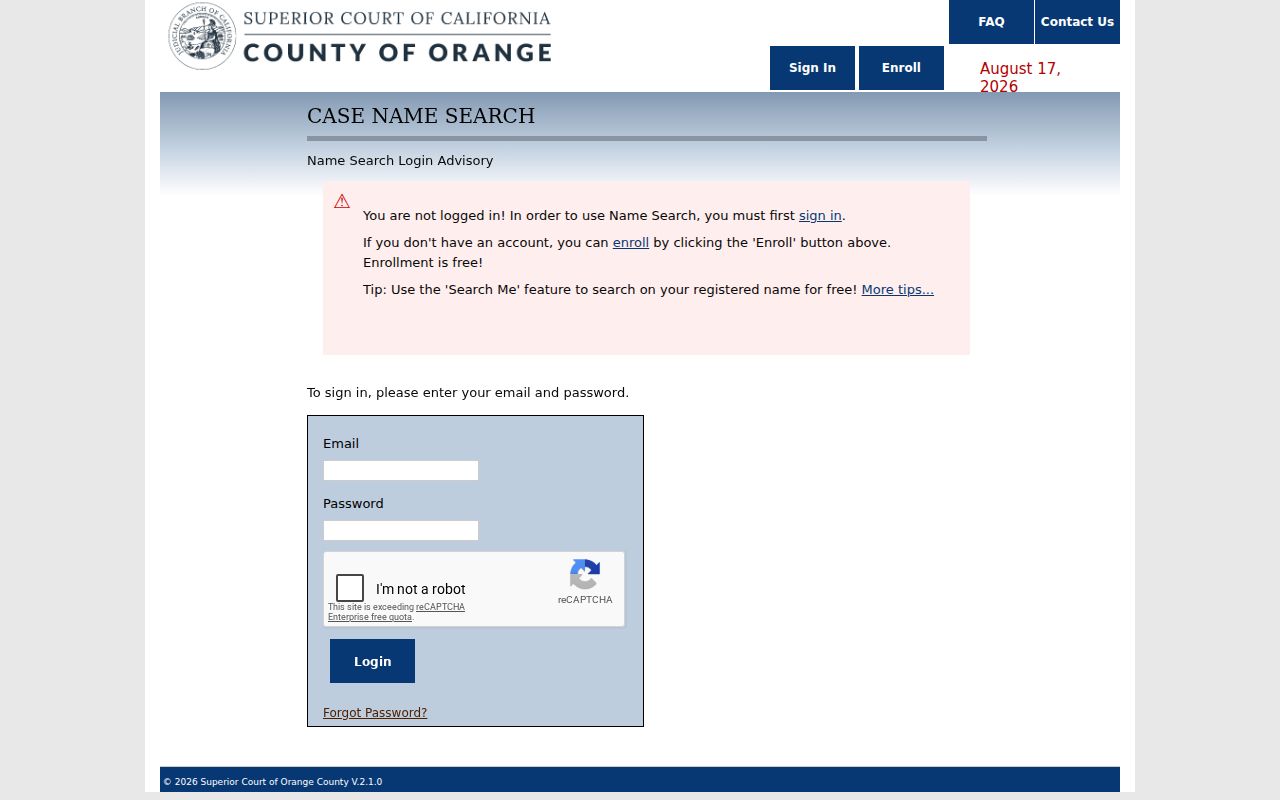
The entry screen makes the enrollment and sign-in boundary visible before a name is treated as a court result.
Fountain Valley Court Results and Remote Records
The court result can show a case number, filing date, party names and roles, case type, justice center, register-of-actions events, hearing dates, and dispositions where the record is remotely disclosable. Document links depend on the case type and filing date, and fees may apply. A sealed or confidential matter can show only limited identifying material or a notice that access is restricted. The court warns that remote data is not the official court record and that a name-to-case association may be imperfect.
The court's Case Name Search instructions illustrate the account, refresh, and enrollment distinctions that matter before a name is treated as a match.
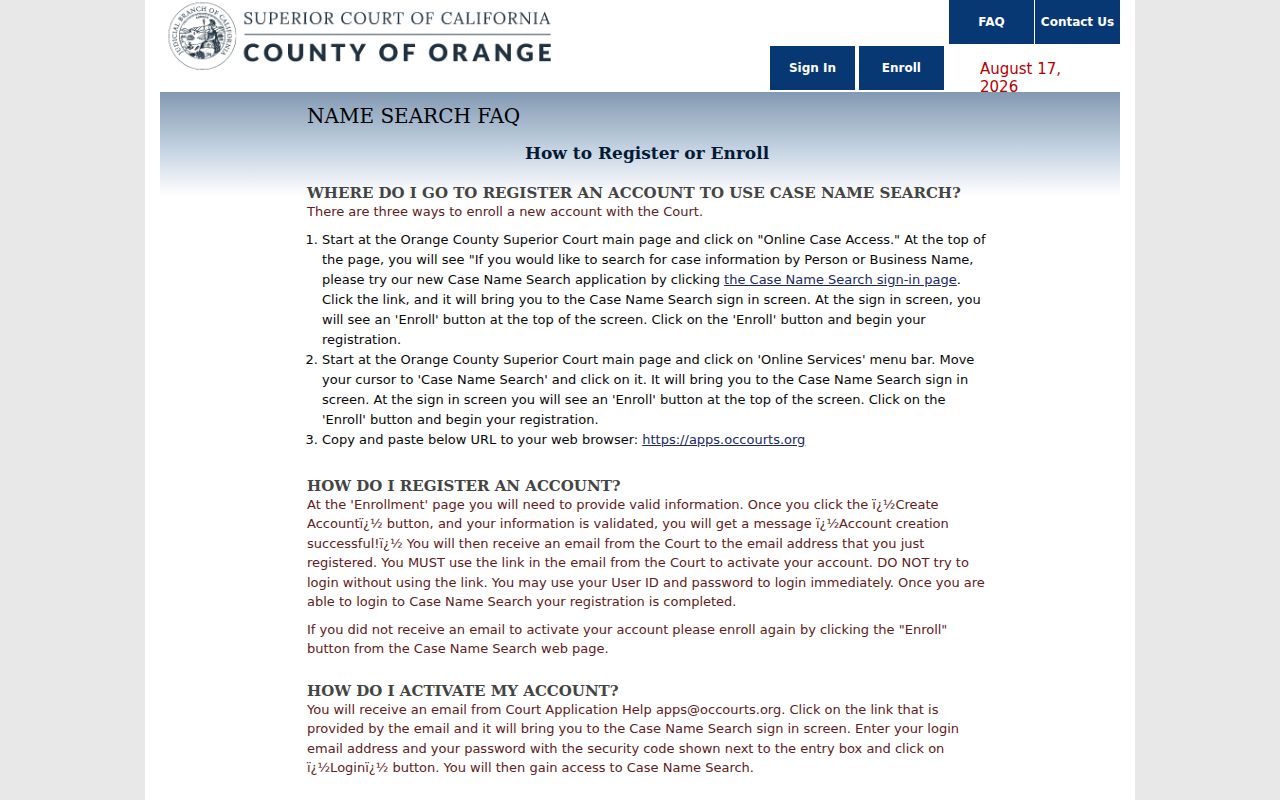
The daily refresh helps with current indexing, but it does not turn a remote result into a complete historical file. The civil records page says Superior Court records may be searched from 1889 to the present. Indexes for older years that are not online remain at the relevant justice centers.
| Result field | What the record may show |
|---|---|
| Case identity | Case number, filing date, party names and roles, case type, and justice center. |
| Case activity | Register of actions or docket events, hearings, and dispositions when remotely available. |
| Documents | Links vary by case type and filing date; remote viewing or download fees may apply. |
| Restricted result | Sealed, juvenile, adoption, confidential, or otherwise restricted content may be omitted. |
Remote access has separate windows. Unlimited and complex civil summaries or registers generally reach back to 1996, limited civil material generally to 2005, and most civil documents filed on or after January 1, 2008 may be viewable or downloadable for a fee. For older or non-imaged files, the Central Justice Center at 700 Civic Center Drive West in Santa Ana provides public computers for many unlimited civil matters. A valid photo ID may be held during a file request, older files can be off-site, and retrieval can take days.
The civil copy route also provides a counter and request fallback. Central Records publishes 657-622-8736, cjcrecordsmanagement@occourts.org, and form L-3009 for copy requests. A federal matter is separate: use PACER for the U.S. District Court, Central District of California, rather than assuming an Orange County state case portal contains it.
The official civil record-copy instructions show why a result screen and the underlying file are different access layers.
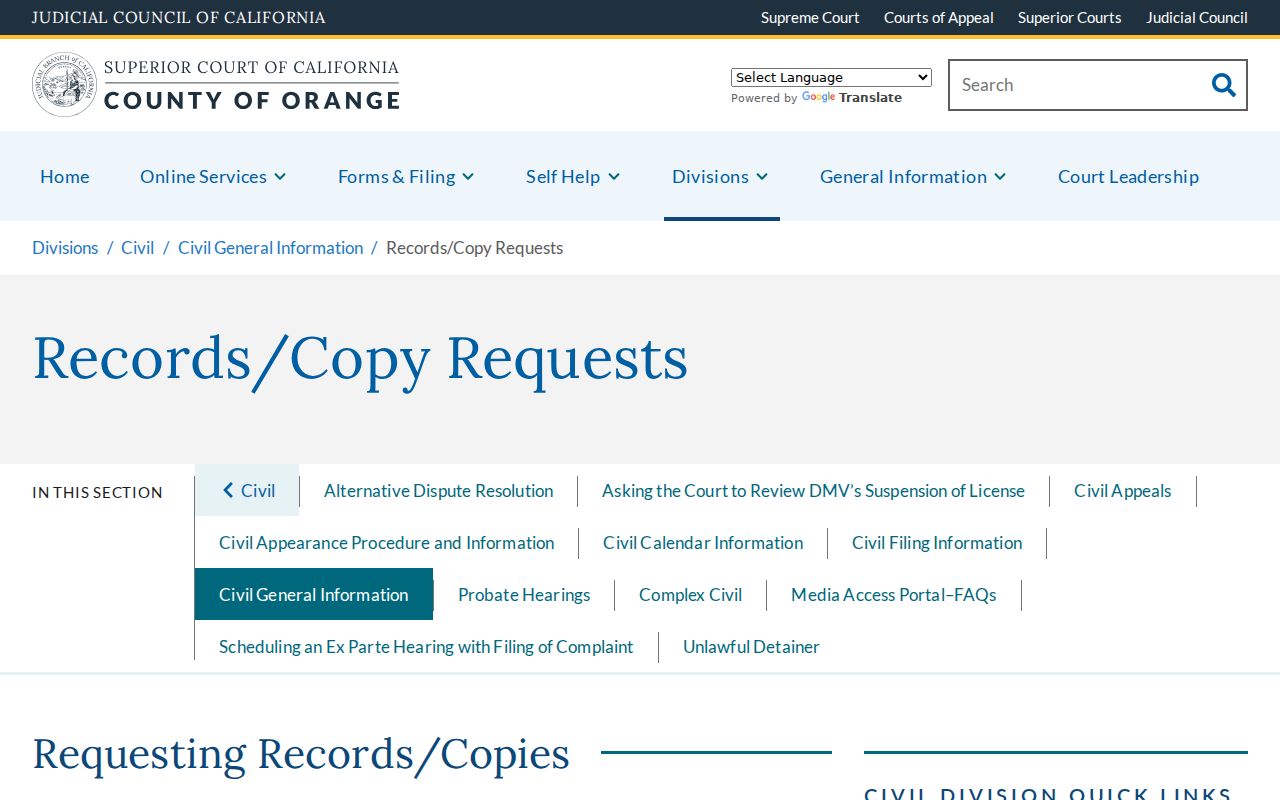
A copy request should identify the case number and document sought. It should not ask staff to infer a private biography from a party name.
Verify One Fountain Valley Resident Step by Step
One-person verification is strongest when a name moves through separate custodians in a known order. A Fountain Valley resident lookup should stop at the first unresolved conflict. The goal is not to collect every possible hit. It is to anchor one person to a dated fact, test that fact against another record, and stop when the evidence does not agree. A deed can anchor an owner to a parcel, while a court docket can anchor a party to a case. Neither one alone proves present occupancy.
- Write the target name, variants, known dates, geography, and the reason the record is relevant.
- Use the Assessor route or another known address to capture the APN, situs address, mailing address, and legal description. Treat the assessed owner as a title clue, not an occupant finding.
- Run Orange County court party searches with the name and variants. Compare case number, filing date, party role, justice center, and docket events before treating a result as the same person.
- Check a vital index or eligible record for the event that fits the chronology. Do not treat a restricted adoption file or confidential marriage as an open substitute for proof.
- Order a copy only from the custodian when the document is needed. Save the source, record date, identifier, and access layer so a later reader can repeat the check.
If an online path stops, the next step may be a justice-center visit, a mailed copy request, a city CPRA request for an existing releasable record, or a library reference question. The correct fallback depends on the record keeper, not on the person's name.
- Docket
- A chronological log of filings, hearings, orders, and other case events. It is not the full set of papers filed in the case.
- Index versus image
- An index points to a record through names and identifiers. An image or copy is the underlying document. RecorderWorks is an index and does not display deed images online.
- Certified copy
- A copy that the custodian attests is a true reproduction of the held record. It is different from an informational copy or an index entry.
Fountain Valley Vital Records and Eligibility
Vital-record access depends on the event and the custodian. The Orange County Clerk-Recorder issues county birth and death copies for all years in the county and public-marriage copies when the license was issued there. The Orange County Health Care Agency serves as local registrar for current-year and preceding-year births and deaths. CDPH Vital Records maintains statewide birth, death, fetal death and stillbirth, marriage, and dissolution records. A confidential marriage comes only from the issuing county clerk to a party to the marriage or by court order under Family Code §509. A divorce decree comes from the Superior Court; a CDPH dissolution certificate is a different, limited vital-statistics record.
California does not use a simple rule that makes every modern birth or death certificate public after one number of years. Authorized certified copies and informational certified copies follow Health and Safety Code §§103526 and 103526.5. Adoption files and specified amendment files remain confidential. Historical statewide indexes have collection-specific coverage, so an index clue does not remove copy eligibility rules.
- Birth certificate: the 2026 CDPH fee is $31.
- Death certificate: the 2026 CDPH fee is $26.
- Marriage certificate: the 2026 CDPH fee is $19.
- Dissolution certificate: the 2026 CDPH fee is $18.
- Fetal death certificate: the 2026 CDPH fee is $23.
- Stillbirth certificate: the 2026 CDPH fee is $28.
CDPH forms VS 111, VS 112, VS 113A, and VS 113B request event facts, names, dates, places, applicant identity, relationship, purpose, contact details, mailing address, and copy count as applicable. Authorized-copy requests use the applicable sworn statement. A mailed sworn statement generally needs notarization. Fees are retained when no record is found, and checks or money orders are payable to CDPH Vital Records.
As of July 1, 2026, CDPH no longer accepts applications submitted through online third-party vendors and directly processes mail applications. Use the official CDPH application index and confirm the current form, fee, and custodian before mailing. A vital record can close one step in a Fountain Valley resident lookup by verifying an event; it is not automatically a current address record.
Fountain Valley Voter Lookup Rules
The Orange County “Your Voter Information” tool is a self-verification screen, not a public name directory. It asks for the voter's date of birth in mm/dd/YYYY format, the last four digits of a California driver license or California ID, or the last four digits of a Social Security number when no California ID or license exists, and the first three letters of the first name. The identity gate is the central feature of this route.
- Date of birth, entered as a full birthday.
- Last four digits of a driver license or California ID, with the alternate last-four SSN field when applicable.
- First three letters of the first name.
- After verification, registration status, name, mailing address, party, voter history, elected officials and districts, sample ballot, and ballot tracking may display.
- Voter history records credited participation, not the choices marked on a ballot.
Specific or bulk voter data follows a different route under Elections Code §§2188, 2194, and 18109, Government Code §7924.000, and 2 CCR §§19001-19013. The applicant states an authorized purpose, requested geography and fields, and security arrangements. A wet signature, clear identification, and supporting documents are required. Applications go in person or by mail; email and fax are not accepted. A specific-voter request is limited to ten voters per application, and payment comes before processing.
The county's 2025 application lists $37 for a standard electronic countywide registered-voter file with voting history, $30 per record for a specific-voter request up to ten, and a $100 maximum for that request type. Confirm the current fee before ordering. Pickup or paid shipment is available. The Orange County Registrar of Voters is listed at 1300 S. Grand Avenue, Building C, Santa Ana, CA 92705, 714-567-7600. Aggregate registration views remain the safer civic layer: they summarize counts by city, district, year, and party rather than exposing a household roll.
Fountain Valley Heir and Business Records
A probate question calls for a court trail, not a guess from a surname. Start with public probate case access, then obtain a petition or order when it is disclosable. A probate filing may identify a decedent, petitioner, or heirs in a public case, but access varies. A later recorded deed can corroborate a transfer. Keep the probate case number, filing date, and legal description together rather than merging relatives with similar names.
For a former classmate, the Fountain Valley Library at 17635 Los Alamos Street is a reference starting point for Orange County directories, newspapers, yearbooks, and genealogy databases. The library says Ancestry Library Edition requires a full-privileges OC Public Libraries card and in-branch use. HeritageQuest supplies census, local-history, and mapping material, while Fold3 supplies military records and personal documents. The exact Fountain Valley directory run is not published online, so reference staff should confirm the title, year, locality list, and any reverse section before a visit. The OC Public Libraries genealogy collection is the reliable entry point for those licensed resources.
For a business affiliation, search Secretary of State bizfile by entity name or number and review status or type filters. A result may show an entity number, jurisdiction, formation or registration date, addresses, agent information, and filings under the service rules. Department of Consumer Affairs search can use board, license type, name, license number, city, or county and may return status, address of record, issue or expiration information, and discipline links as applicable. Orange County fictitious-business-name filings and Fountain Valley business-license records answer still other questions. These records establish an organization or credential connection, not a home address.
Fountain Valley Lookup Privacy Programs
California's Safe at Home program gives eligible survivors and other protected participants a substitute mailing address and confidential mail-forwarding. Government Code §6205 et seq. governs the program. Safe at Home does not erase every historical public record, so a protected person may be absent from one route while an older lawful record remains with its custodian. The official Safe at Home program explains the protected-address path.
The California Consumer Privacy Act, Civil Code §1798.100 et seq., provides covered consumers rights to know, delete, correct, limit some sensitive-information use, and opt out of sale or sharing, subject to exemptions. California's Delete Request and Opt-out Platform, known as DROP, launched in 2026. Registered data brokers begin deletion processing obligations on August 1, 2026. The California privacy agency's DROP information is the proper starting point. A deletion request does not erase a lawful deed, assessment record, or court source record held by a public custodian.
When a result is wrong, contact the specific custodian and ask about its correction, redaction, or amendment procedure. The Driver's Privacy Protection Act, 18 U.S.C. §§2721-2725, limits obtaining and disclosing personal information from state motor-vehicle records outside permitted purposes. That federal rule is another reason a name search cannot be expanded into a search for protected delivery or driving data.
Lawful Limits on a Fountain Valley Resident Lookup
California records access is not permission to watch, threaten, or force contact with another person. Penal Code §646.9 addresses stalking, and Code of Civil Procedure §527.6 provides a harassment restraining-order path. Voter information carries separate misuse limits under Elections Code §18109, and the DPPA restricts motor-vehicle personal information. A custodian's public record should be used for a lawful personal purpose such as genealogy, an estate question, reconnecting, civic research, or a safety concern that is handled through the proper agency.
Lawful use. A Fountain Valley name search is a research aid, not permission for surveillance or unwanted contact. Do not use a record to stalk, harass, intimidate, or harm anyone; when a safety issue exists, use the appropriate public-safety or court channel.