
Using the Fountain Valley Residents Directory
Fountain Valley does not publish one city-run household roll. The durable name and address trail sits across Orange County offices, state systems, the courts, and local reference collections. The best first source depends on the clue in hand. An address points toward the Assessor, GIS, and recorded documents. A full name may lead to a court party search, a business filing, a professional license, or a historical directory. A past resident may require a dated directory, a newspaper, probate material, or a deed chain.
Each source answers a narrower question than its label may suggest. The assessed owner is not automatically the person who occupies a parcel. A tax mailing address is not the same as the situs address, which means the physical parcel location. A directory entry reflects a publication year and its own listing rules. Voter information is controlled, and the public lookup verifies the voter's own record rather than opening a street-by-street list. A careful Fountain Valley residents directory search keeps those limits beside every result.
- Start with the address, name, or date that is already known. Standardize the street line, keep former surnames and initials, and note the record date that will frame the search.
- Use the Orange County Assessor property gateway or GIS route to resolve an address to an APN. Save the displayed owner, mailing address, situs address, legal description, and parcel facts as an as-of snapshot.
- Use the Clerk-Recorder's grantor and grantee index for the names tied to a deed or lien. The index supplies a document trail; a separate copy request is needed for the legal description and the full instrument.
- Choose the next confirming record. Orange County Superior Court can connect a name to a case, state license or business records can establish a dated public affiliation, and the voter route is available only through its identity-gated or authorized channels.
- When the online trail stops, ask a focused question of the City Clerk, visit a documented counter, use the library reference desk, or contact the Archives. For an address-first walk, the Fountain Valley street directory sequence keeps the parcel and deed steps together.
Fountain Valley Records Desks
Orange County is the main records geography for Fountain Valley. The Clerk-Recorder holds recorded documents and vital-record services. The Assessor provides the property gateway and a public counter. The Registrar of Voters controls registration information. The City Clerk handles city-held records, while Orange County Superior Court handles trial-court matters because Fountain Valley has no separate municipal court. These desks should not be treated as interchangeable versions of a resident list.
Orange County Clerk-Recorder
601 N. Ross Street
Santa Ana, CA 92701
714-834-2500
Orange County Assessor
500 S. Main Street, second floor
Orange, California
Public counter access
Orange County Registrar of Voters
1300 S. Grand Avenue, Building C
Santa Ana, CA 92705
714-567-7600
At the city level, the City Clerk is at 10200 Slater Avenue and can be reached at 714-593-4445. The public-records route accepts a focused request through the city process, at the clerk counter, or through the published email route. The request should identify an existing category, date range, address, parcel, project, permit, or case number. It should not ask staff to create a new list or answer a research question. That boundary keeps the Fountain Valley residents directory tied to the record a custodian actually holds.
Fountain Valley Property Search Fields
The Orange County Assessor property information and parcel maps gateway points users toward ParcelQuest and public property data. The useful first move is an address search that returns the APN, then a check of the displayed legal description and situs line. The county warns that linked data should be verified with the Assessor. Owner-name search capability is not confirmed on the county landing page, so an unrestricted name export should never be promised.
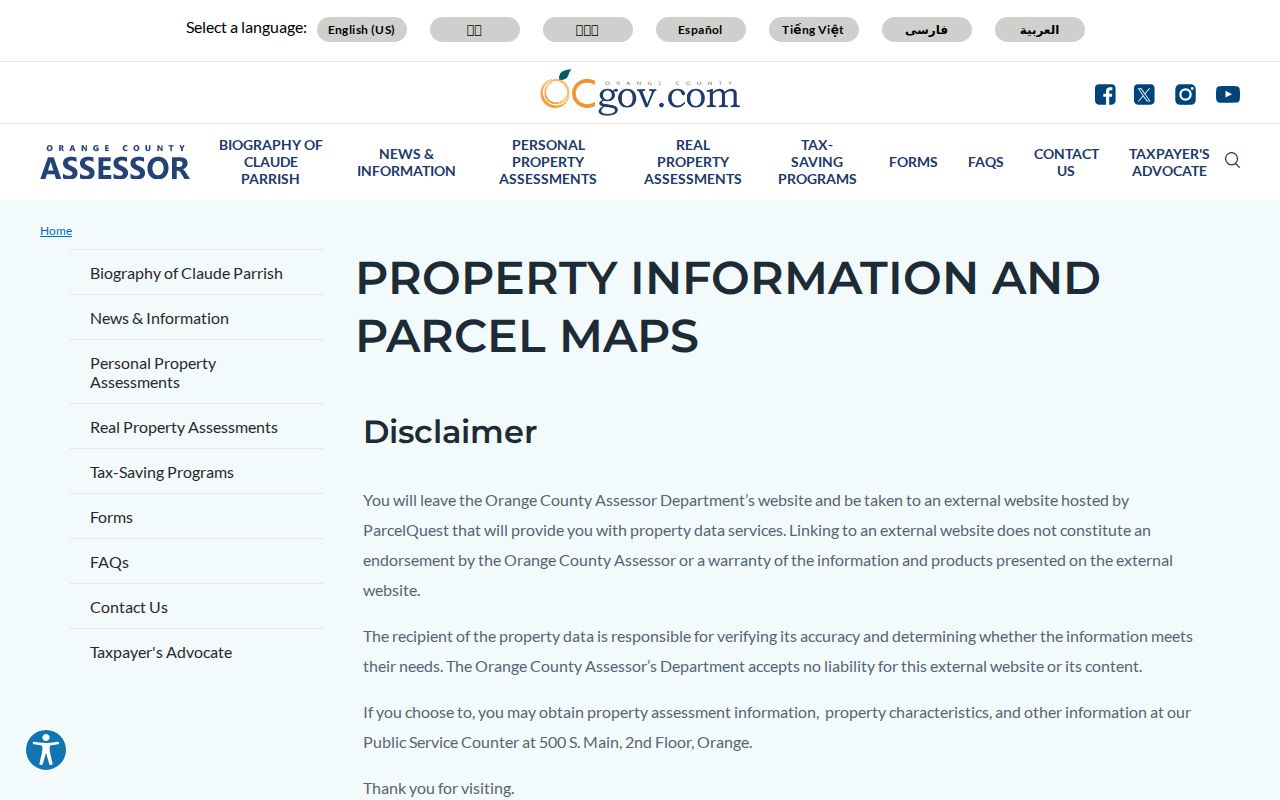
The image shows the public gateway that anchors a property-first search. It is most useful when the address is known, when a parcel map must be tied to a deed, or when a name needs a second anchor. Counter service is available at 500 S. Main Street, second floor, in Orange for assessment information and property characteristics.
| Assessor field or control | How it functions in a Fountain Valley search |
|---|---|
| Address | One search key; standardize the street number and name, and account for unit handling. |
| APN | One search key; retain the displayed Orange County hyphenated parcel format. |
| Owner name | Capability is not confirmed on the county landing page; verify the current ParcelQuest tier before relying on it. |
| Search or Reset | Portal controls; the linked third-party gateway does not replace county verification. |
A parcel card may show an assessed owner, tax mailing address, situs address, legal description, assessed land and improvement values, tax-rate areas, and selected characteristics. Those fields describe the parcel and the assessment snapshot. They do not prove who occupies the address, and they do not turn the Fountain Valley residents directory into a complete household list.
Fountain Valley RecorderWorks Is an Index
Recorded documents create the clearest ownership trail, but the Orange County RecorderWorks grantor and grantee index is a locator rather than an online deed-image library. Search both party roles, try spelling and former-name variants, and narrow a common name with a date range. A result can show indexed grantors and grantees, document type, recording date, instrument number, and an older book and page reference when that field is available.
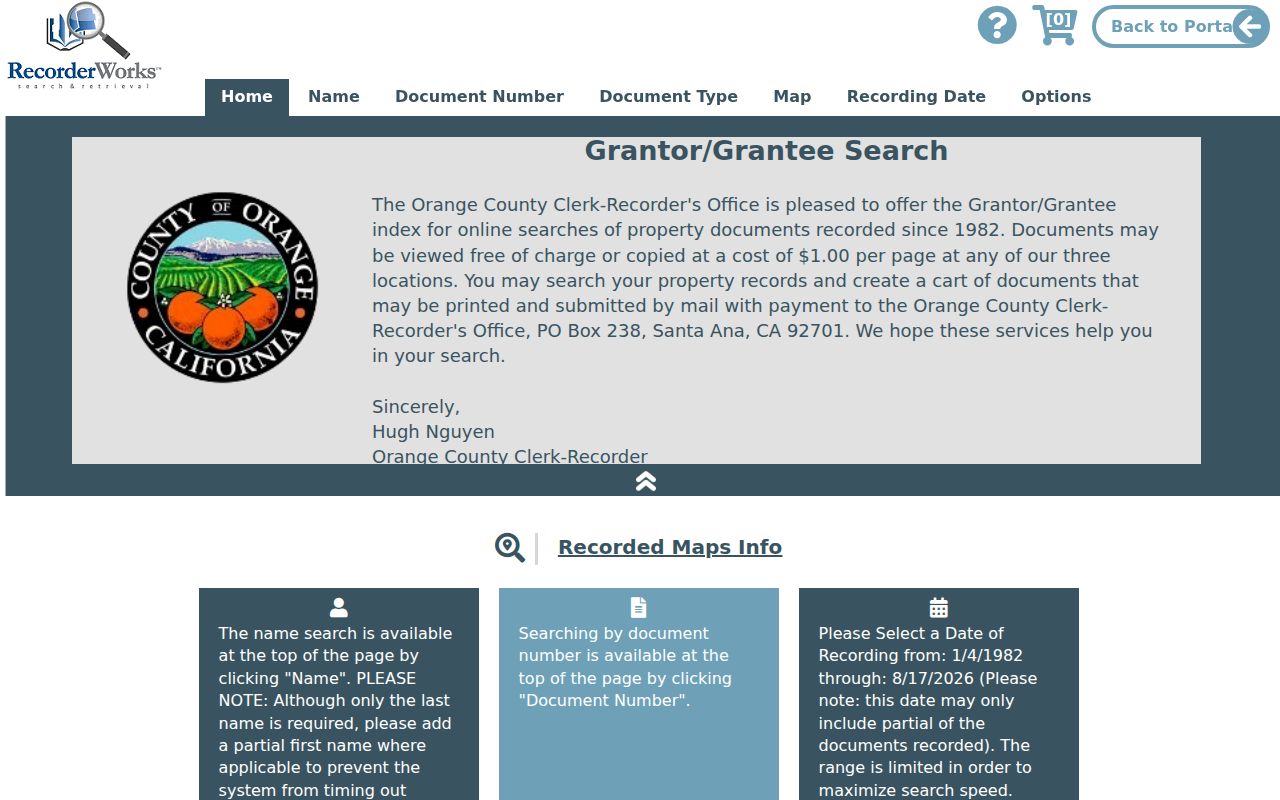
The RecorderWorks screen is a useful starting point for a deed chain, but it does not display the legal description, signatures, return address, or transfer-tax information. It also does not display public images. Staff will not conduct the underlying name search by phone, mail, or at the counter, so the researcher must identify the document number before ordering.
For 1982-forward records, the copy request uses the recording year and six-digit instrument number. Older records may require book, page, and instrument references. The official copy process lists $1 per page plus $1 certification per recorded document or map. Mail requests go to the Clerk-Recorder at 601 N. Ross Street, Santa Ana, with a self-addressed stamped envelope. A tax lien or deed result is evidence about a recorded transaction, not proof of present occupancy.
Fountain Valley Voter Access Is Controlled
The Orange County voter route is narrower than many directory searches assume. The Your Voter Information lookup is an identity-gated self-check. It asks for the full date of birth, the last four digits of a California driver's license or state ID, or the last four digits of a Social Security number when no California ID is available, plus the first three letters of the first name.
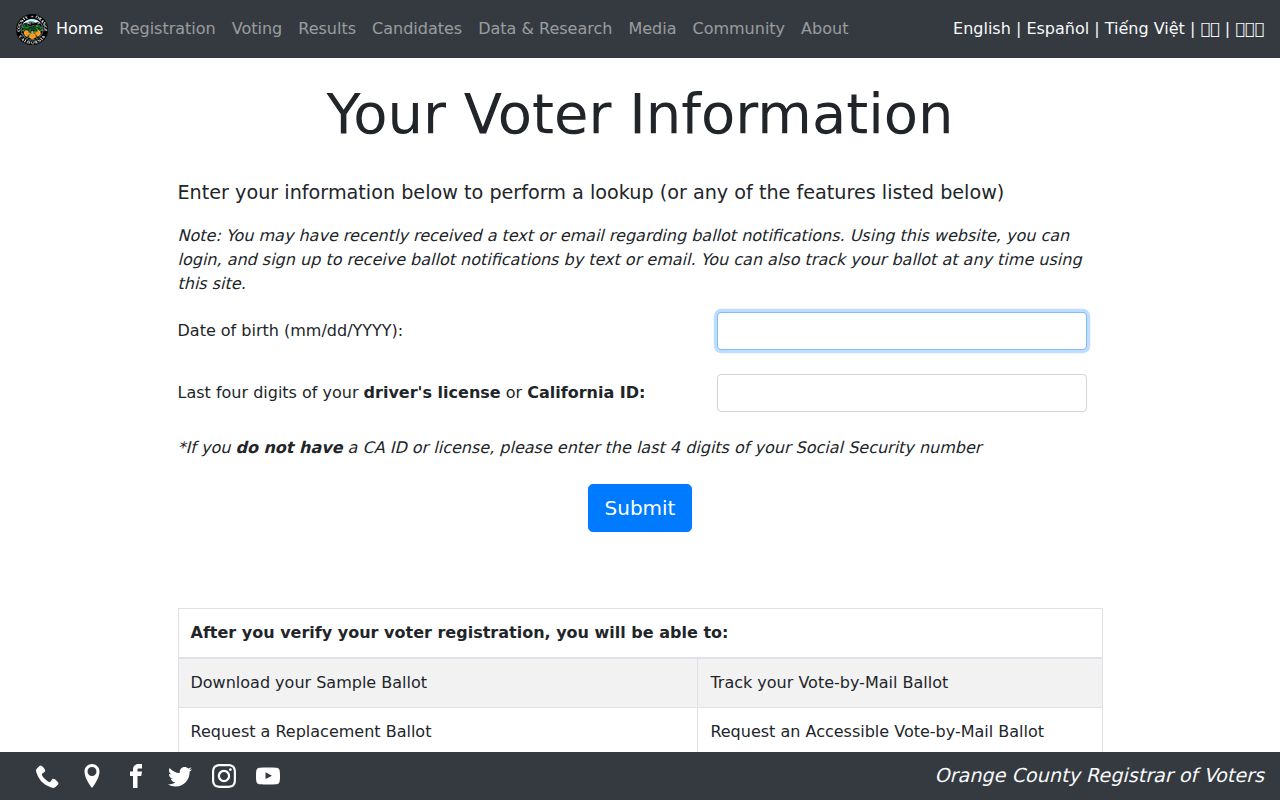
After verification, the result can include registration status, name, mailing address, party, voter history, elected officials and districts, a sample ballot, and ballot tracking. Voter history shows an election in which a ballot was credited. It does not reveal ballot selections. The tool is not a public street browser and cannot be used to list the people on a block.
Controlled voter data requires a separate application. The county requires an authorized purpose, security information, a wet signature, supporting documents, clear identification, and advance payment. Submission is in person or by mail, not email or fax. A specific-voter request is limited to ten voters per application. The county's application materials list a standard electronic countywide file at $37, specific requests at $30 per record up to ten, and a $100 maximum for that request type; current fees must be checked before ordering. Data Central supplies safer aggregate counts by city, district, year, and party.
Fountain Valley Court Search Doors
Orange County Superior Court is the trial court for Fountain Valley. Its Case Access choices separate civil, criminal and traffic, family, probate, and small-claims matters. The separate Case Name Search uses person or business names, requires enrollment and sign-in, refreshes daily, and returns matching case numbers and filing dates before opening the register of actions for a selected case.
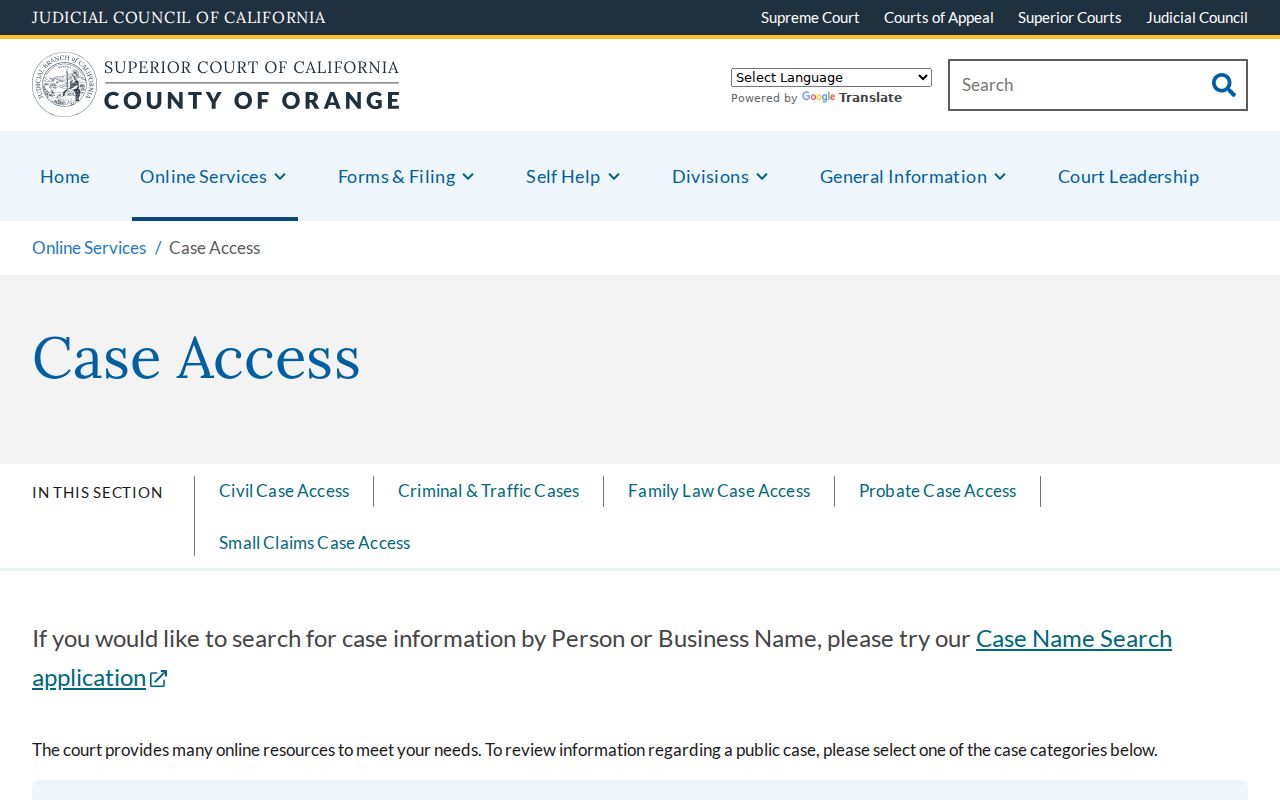
The case result can include a case number, filing date, party names and roles, case type, justice center, docket events, hearing dates, and dispositions when the material is remotely disclosable. Document links vary by case type and filing date, and fees may apply. A name and case association can be imperfect, so a filing date, address clue, or second record is needed before treating a result as the right person.
Online coverage is layered. The civil records service describes searches from 1889 to the present, while older indexes that are not online remain at the relevant justice center. Remote summaries generally reach 1996 for unlimited and complex civil matters and 2005 for limited civil matters; most civil document images begin in 2008. Central Justice Center at 700 Civic Center Drive West in Santa Ana provides public computers for many unlimited civil matters. Central Records publishes 657-622-8736, cjcrecordsmanagement@occourts.org, and form L-3009 for copy requests. Federal cases use PACER and the Central District of California rather than the county court portals.
Current Fountain Valley Residents Directory Sources
Current sources work best as a set of narrow records. None is a complete list of every person connected to an address. The property route is strong for assessed ownership, the deed index is strong for recorded parties, the court route is strong for dated case associations, and business or license registers can corroborate a public affiliation. The library can add a historical or family-history clue. Each source adds one carefully dated layer to the Fountain Valley residents directory. A Fountain Valley resident lookup is useful when the goal shifts from a parcel or record set to one person.
| Source | Who or what it lists | Keeper | Access |
|---|---|---|---|
| Assessor parcel record | Assessed owner, mailing and situs facts | Orange County Assessor | Public gateway and counter |
| RecorderWorks index | Parties to recorded deeds, liens, and maps | Orange County Clerk-Recorder | Free index, paid copies |
| Voter self-record | One voter's status, mailing address, and history | Orange County Registrar of Voters | Identity-gated or authorized route |
| City Clerk records | Existing public city records tied to an address, project, or case | City of Fountain Valley | Portal, counter, email, or focused CPRA request |
| Library reference sources | Dated directory, newspaper, census, and family-history clues | Orange County Public Libraries | Branch or licensed database access |
The table's last row is important for earlier residents and for a name that has changed. The first four rows still need date checks and source limits. A city officials page identifies public servants and custodians, not private household members. Neighborhood or association lists should be treated as private unless the organization deliberately publishes a contact page.
Fountain Valley Business and License Checks
A business or license record can corroborate a person, name variant, or public affiliation without turning the result into a residence claim. The California Secretary of State bizfile Online search covers corporations, LLCs, and limited partnerships. Common result fields include entity name and number, status, jurisdiction, formation or registration date, addresses, and agent information. Filed statements depend on the service rules.
The business search image shows a state entity route that can help separate two people with the same name or connect a dated name to a registered organization. It does not establish a home address. Orange County fictitious-business-name records answer a different question by associating a local trade name with a registrant statement, while a Fountain Valley business-license record may be requested as an existing city record when no public search field is verified.
The California Department of Consumer Affairs license search covers participating boards and can return status, license number, address of record, issue or expiration information, and discipline links when applicable.
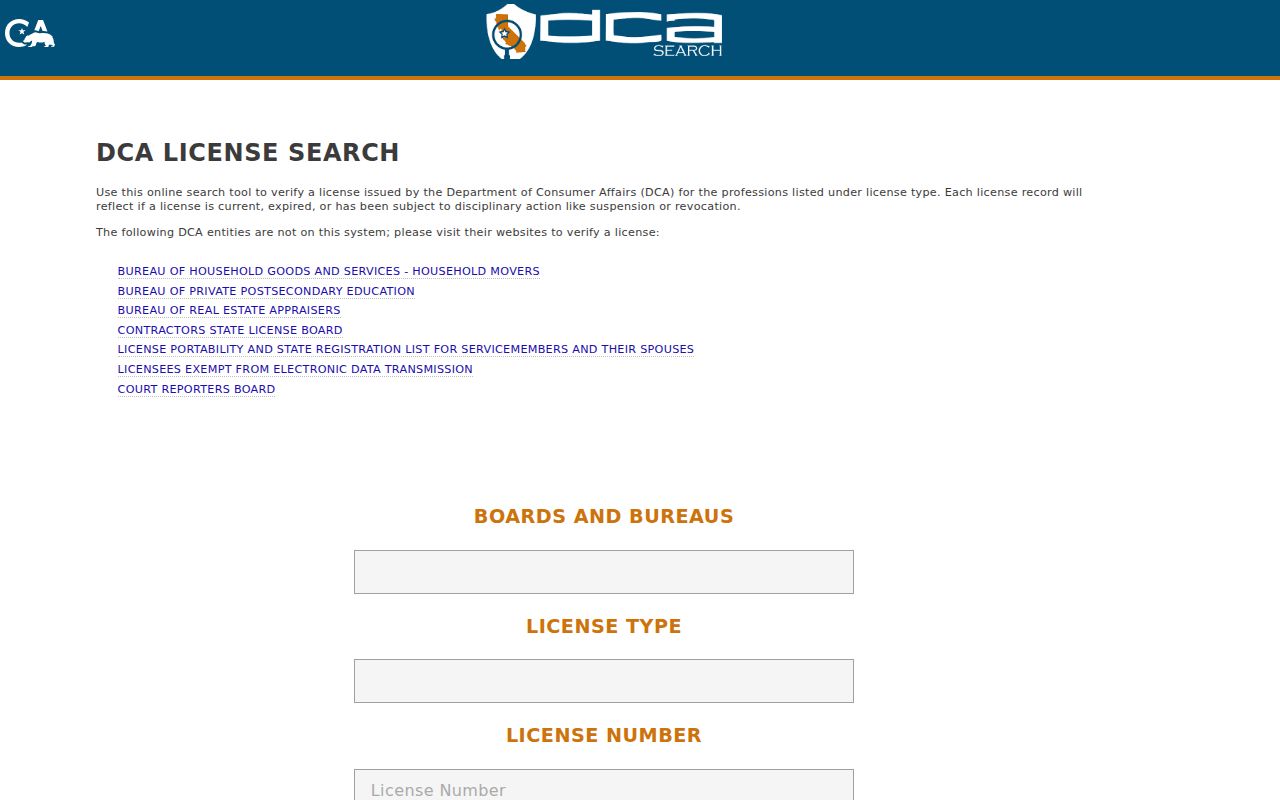
The professional search adds a second public custodian. Compare the name, city or county, license number, and date rather than merging a result on a name alone. Business filings, fictitious-business-name statements, city records, and professional credentials describe different public roles.
| Official roll | Strength | What a commercial people-finder category may add |
|---|---|---|
| Assessor and recorded documents | Named parties, parcel, legal and recording clues | Compiled addresses may be stale or combine people |
| Court, business, or license record | Dated public affiliation or case trail | Paid summaries may omit context and source dates |
| Library directory or newspaper | Publication-year household or event clue | Aggregated profiles are not primary evidence |
Fountain Valley CPRA and Counter Fallbacks
When a portal ends at a search result, use the custodian's next documented channel. The Fountain Valley City Clerk's public-records process can accept a request at the counter or through its email route. The city says it will give notice within ten days about whether responsive disclosable records exist, with a possible 14-working-day unusual-circumstances extension. Inspection is by appointment. Paper duplication is listed at $0.10 per page, requests over 50 pages may require a deposit, and gathered records remain available for ten days after notice.
The request should name an existing record category, date range, address, parcel, project, permit, or case number. The city archive should be searched before asking for records. Building records are an address-keyed trail, and the Police Records Bureau handles its own process with requester and exemption rules. Building Division counter hours are Monday through Thursday from 7 a.m. to 6 p.m., closed Friday, and the published phone is 714-593-4429.
County fallback channels are just as specific. The Assessor counter can help when the property gateway fails. The Clerk-Recorder accepts copy requests by mail or through its service counter after the document number is identified. Older Superior Court indexes and non-imaged files may require a justice-center visit. The Fountain Valley Library at 17635 Los Alamos Street can check catalogs, licensed databases, newspapers, yearbooks, telephone books, and local-history files. The Old Orange County Courthouse Archives room in Santa Ana is a further research route for historical property, vital, directory, newspaper, map, and photograph material. Verify hours and access rules before travel.
Vital records have their own access split. The Orange County Clerk-Recorder issues county birth, death, and public-marriage copies; the local registrar handles current and preceding-year births and deaths; CDPH-Vital Records handles statewide applications by mail. Confidential marriage records come only from the issuing county clerk for a party or court order, and a certified divorce decree comes from Superior Court rather than from a CDPH dissolution certificate. Authorized and informational copies follow different California rules, so an index clue is not a substitute for an eligible certified copy.
Historical Fountain Valley Resident Directories
Older residents are often found in regional volumes rather than a book titled only for the modern city. Orange County Public Libraries recommends a catalog and reference approach that includes Orange County, Santa Ana, Huntington Beach, Westminster, and Fountain Valley. Ask for telephone directories, city or suburban directories, reverse or criss-cross volumes, newspapers, yearbooks, obituary tools, census databases, and local-history files. Ancestry Library Edition requires a full-privileges OCPL card and in-branch use. HeritageQuest supplies census and family-history material, while Fold3 supplies military and personal records.
The UCI Orange County Regional History Collection finding aid identifies a 1950 to 1990 directory collection with verified sub-runs for Orange County in 1963 to 1965, Santa Ana and Central Orange County in 1952 and 1962, South Coast Area in 1969 to 1970, South Orange County in 1969 to 1980, and Saddleback Valley in 1979 to 1980. A regional title is not proof of Fountain Valley coverage. Inspect the title page and locality list, and ask the repository about an unprocessed collection or restrictions.
A reverse or criss-cross directory changes the search direction. Instead of name to address, it can place a listed adult beside a street and house number for a publication year. The listing may omit a household because of canvassing gaps, an unlisted phone, a new tract, or a boundary choice. A full treatment of the historical shelf belongs with the Fountain Valley city directory collections, while the home workflow only uses the collection as one dated clue.
Talbert Before the Fountain Valley Directory
Place names matter when a search goes backward. Orange County was created in 1889 from Los Angeles County, and Fountain Valley incorporated in 1957. Before incorporation, permits, governmental references, and directory entries may use Talbert, rural Orange County descriptions, township or enumeration geography, or a broader regional heading. A modern city label is therefore a weak key for the earliest part of a record trail.
The first local post office opened as Talbert in 1899, while artesian wells helped inspire the later Fountain Valley name. The city also incorporated partly to avoid annexation and then used a master-plan approach during major postwar growth. Those facts explain why a modern tract, a county map, and a regional directory can describe the same land in different ways.
Use the legal description, APN, tract and lot references, and contemporary map language to bridge the change. Do not import a generic courthouse-fire story into an old-resident search. The research found no authoritative evidence that a fire destroyed Orange County's core record books. The more honest gap is that exact first and last Fountain Valley directory years and publishers still need catalog confirmation.
Fountain Valley Same-Name Checks
A name is a starting point, not a match. Normalize hyphens, spaces, initials, suffixes, former surnames, and diacritics. Then look for two independent anchors. An APN paired with a deed party is stronger than a name alone. A court case paired with its filing date and party role is stronger than a case number copied without context. A license number, entity number, instrument number, or exact parcel description can break a tie between similar names. That second-anchor habit makes a Fountain Valley residents directory result more useful for family history and source checking.
Chronology matters. An assessor record is an annual snapshot, a deed records a transfer date, a court docket follows a case, and a directory belongs to its publication year. A record that fits the place but not the date should remain unconfirmed. The same rule applies to a business or license result. A mailing address can be a trust, management, or correspondence address, so it should not be restated as a person's current residence without a separate source.
- Resident roll
- A record set organized around a narrow purpose, such as assessment or registration, rather than every household member.
- Index
- A locator for a fuller record. RecorderWorks points to a document but does not replace the deed copy.
- Parcel
- A mapped land unit identified by an APN, with legal and map references that can outlast a street label.
- Criss-cross directory
- A publication that reverses the usual name-first order and places listed people beside an address for a given year.
Fountain Valley Privacy and Safe at Home
California privacy rules shape how a public-record search should end. The California Consumer Privacy Act gives covered consumers rights to know, delete, correct, limit certain sensitive-information use, and opt out of sale or sharing, subject to exemptions. The 2026 Delete Request and Opt-out Platform adds a state route for requests to registered data brokers, but deletion from a commercial profile does not erase a lawful deed, assessment, or court source record.
Safe at Home is different from a routine opt-out. The Secretary of State program gives eligible survivors and other protected participants a substitute mailing address with confidential mail-forwarding. It does not erase every historical public record. Voter information is also controlled, and protected voters or confidential identifiers are withheld or handled under special rules. If a record is wrong, request correction from the custodian that created it; convenience alone is not a basis to remove truthful public material.
Lawful personal use. Fountain Valley records are available for careful, lawful research, family history, civic review, and source verification. Access never authorizes threats, surveillance, unwanted contact, or intimidation; California Penal Code section 646.9 and Code of Civil Procedure section 527.6 address stalking and harassment, and the federal Driver's Privacy Protection Act limits motor-vehicle address data.
2026 Fountain Valley Records Changes
Several 2026 changes affect the practical record path. California vital-record fees rose January 1 to $31 for birth, $26 for death, $19 for marriage, $18 for a dissolution certificate, $23 for fetal death, and $28 for stillbirth. A no-record result still consumes the fee. The state also announced that direct mail processing replaced online third-party submissions on July 1, 2026. Use the CDPH Vital Records fee guidance and current application instructions before mailing a request.
California's DROP platform launched in 2026, with registered data brokers beginning deletion processing on August 1. Orange County also highlighted 2026 real-property fraud courtesy notices that send an owner the first page of a newly recorded document. A notice is a warning service, not proof that a mailing is official; compare any solicitation with the Clerk-Recorder's published copy charges and contact route.
CDPH also began accepting specified diacritical-mark amendment requests in 2026. Older indexes may omit marks, so a search should try alternate spelling, spacing, former surnames, initials, and the unmarked form. These updates do not change the central Fountain Valley residents directory method: identify the custodian, preserve the record date, and corroborate a result before relying on it.