
Fountain Valley Previous Residents by Era
One Fountain Valley address leaves different kinds of evidence in different periods. Recorded deeds follow title. Directories and census schedules list people at a place for a given year. Permits show work at a property, while obituaries and probate filings can close a former resident's trail. No source should be stretched beyond what it actually records. The table separates the main paths and keeps the documented gaps visible.
| Source | Years It Covers | Where Held | What It Shows |
|---|---|---|---|
| Recorded deeds | Orange County records to county formation; online start unverified | Orange County Clerk-Recorder | Owners, transfers, legal description |
| Recorder identifier system | Pre-1982 and 1982-forward formats | RecorderWorks and copy service | Reference needed to locate the recorded copy |
| Regional city directories | Exact Fountain Valley run unverified | OCPL reference and UCI MS.R.121 | Listed adults, spouses, occupations, addresses, reverse entries where included |
| Federal population census | 1790-1950 public release; 72-year rule | NARA and library genealogy databases | Household names, ages, relationships, birthplace, occupation, location |
| Fountain Valley permits | Current portal and historical depth not stated | City Community Development and CPRA route | Project, permit number, dates, contractor, valuation, inspections |
| Sanborn fire maps | Fountain Valley-specific years not verified | Library of Congress and California repositories | Building footprint and older street context where mapped |
| Obituaries and probate | Record-specific | Library newspaper tools and Orange County Superior Court | Death, relatives, petitions, heirs where public |
Start with the era in question. A recent transfer calls for the parcel, deed index, and a copy request. A mid-century household calls for a regional directory and the released census. A deceased owner may lead from an obituary to probate and then to a later deed. The research does not establish an exact Fountain Valley criss-cross run, Sanborn sheet year, permit archive cutoff, or RecorderWorks online start year, so those points remain questions for the custodian or reference desk.
APN First for Fountain Valley Previous Residents
An address is a starting clue, not the strongest long-term key. Standardize the street number and name, then use the Orange County Assessor property-information gateway or its linked parcel service to capture the APN. The public landing page does not confirm an unrestricted owner-name search, so do not promise one. Assessor counter access is available at 500 South Main Street, second floor, Orange. Record the APN, situs address, mailing address, legal description, tract or lot reference, and any displayed characteristics.
Situs and mailing address answer different questions. Situs identifies the physical parcel. Mailing address is where tax correspondence goes and may point to an absentee owner, trust, management address, or a different city. Neither field proves who occupies the property. The APN can also change after a subdivision or combination, so preserve the legal description and tract map before moving to older deeds.
The OC Public Works land-record and GIS gateway can add parcel, city-limit, zoning, aerial, district, survey, and tract-map context. Its map is an aid, not the recorded legal description. The Associated Documents Map can bridge a legal description to record-of-survey, parcel-map, tract-map, corner-record, and lot-line-adjustment references. Capture the document type and date rather than treating a map layer as proof of a household.
Follow Fountain Valley Owners Backward
The deed chain traces title, not every person who lived at a parcel. Begin with the current assessed owner as a research lead, then confirm the transfer in the Orange County Clerk-Recorder record. The RecorderWorks Grantor-Grantee Index is a name-based index. It is not an address search, and the public web tool does not display the deed image.
- Resolve the modern street address to an APN and legal description, saving the tract, lot, and parcel details that can survive an address change.
- Search the current owner's name as grantee, using spelling variants and the recording date range, then note the document number and parties.
- Order the purchase deed through the Clerk-Recorder copy route and read the grantor, grantee, date, instrument reference, legal description, and any return or mailing clues.
- Search the seller as an earlier grantee. Match the same legal description, APN, tract, or map before calling the result the prior transfer.
- Repeat the seller-to-earlier-seller search one deed at a time. Keep a dated chain and flag any name match that lacks a parcel match.
- When the web trail stops, ask the custodian whether deed books, microfilm, or another older index applies. Do not infer the cutoff from a blank result.
- Grantor
- The party transferring an interest in the recorded document.
- Grantee
- The party receiving the interest in that document.
- Chain of title
- The linked sequence of transfers for the same parcel, checked through parties and the legal description.
- Legal description
- The recorded land description, such as a tract and lot reference, used to tie older documents to a parcel.
A clean chain can identify earlier owners, but it cannot turn each owner into a former resident. Use the directory and census layer for that separate question.
RecorderWorks and Fountain Valley Previous Residents
RecorderWorks is useful because the index is free and searchable by grantor or grantee, but it stops short of the recorded instrument. The public instructions require the researcher to find the document identifier first and then order a copy. Staff expressly will not perform the underlying name search by telephone, mail, or at the counter. A blank search result may reflect a spelling choice, date range, older reference system, or an unverified online coverage limit.
The Orange County copy instructions give the mail route: send the request with a self-addressed stamped envelope to Orange County Clerk-Recorder, 601 N. Ross Street, Santa Ana, CA 92701. The general number is 714-834-2500. Recorded-document copies cost $1 per page plus $1 certification per document or map on the cited instructions. Counter service is another copy channel, but current counter details should be confirmed before travel.
Index myth. A RecorderWorks hit locates a document; it does not supply the deed image, prove occupancy, or replace a certified copy from the custodian.
Keep the search result, document number, request date, and copy response together. That small audit trail shows which part of the property history came from an index and which part came from the underlying record.
Fountain Valley Previous Residents: 1982 Break
Orange County's reference formats change at 1982. For a pre-1982 document, the copy request needs book, page, and instrument references when available. For a 1982-forward document, the identifying pattern is the recording year plus a six-digit instrument number. Preserve the exact punctuation and digits from the index. A year and name alone can be too weak for a copy request, especially when several people share a surname.
The 1982 change is a lookup convention, not proof that older deeds are missing or that the public web index began in 1982. The research file does not state the exact online start year for RecorderWorks. If an older Fountain Valley parcel is not found online, ask the Clerk-Recorder what book, page, instrument, microfilm, or counter path applies. Orange County's creation in 1889 also matters: a pre-1889 land trail may point to Los Angeles County-era records or state and federal collections.
Address evidence can shift as subdivisions, tract maps, and municipal labels develop. Hold the legal description beside the modern street number, and do not discard a deed merely because its city line uses an older place name.
Ownership Is Not Fountain Valley Occupancy
Ownership and occupancy are separate claims. An assessor record can display an assessed owner, tax mailing address, situs address, characteristics, and values. A deed can show named parties and a transfer date. A permit can show a project address, permit number, contractor, valuation, and inspection milestones. None of those fields proves who slept at the parcel or which household used it.
The annual assessment roll adds a timing trap. The displayed assessee can reflect the January 1 lien-date snapshot after a later sale. The recorded acquisition deed is better evidence of the transfer date, while the roll remains useful for the annual assessment picture. Compare the two dates before calling someone a current owner or a previous resident.
Directories and census schedules supply a different layer. They can list adults, spouses, occupations, and a street address for a dated publication or enumeration. Renters and other household members may be absent from property sources. A careful house history therefore labels each fact as owner, listed occupant, mailing recipient, permit participant, or census household member.
Fountain Valley Past Residents: Directories and Census
The household layer begins after the parcel is anchored. Regional titles may be filed under Orange County, Santa Ana, Central Orange County, South Coast Area, South Orange County, or Saddleback Valley. The Fountain Valley city directory collections page explains those verified runs and how to read an entry; the address-history task here is to pair the right volume with the right parcel and year.
- Write the address as printed in the known directory or record, including street number, spelling, unit clues, and older place name.
- Read the alphabetical section for a person, then the street or criss-cross section for the house number when that section exists.
- Pair the directory year with the nearest released census, using the 1940 or 1950 schedule where the geography and household can be compared.
- Record names, ages, relationships, spouse notation, address, and any “wid,” “h,” or “r” mark without treating an absence as proof of a move or death.
- Use newspapers, obituaries, vital-record rules, and probate filings to test a disappearance or connect a former household to a later deed.
Federal census schedules are public through 1950 under the 72-year rule. A 1952 directory and 1950 census can offer a near-year comparison, but they remain different snapshots. Changes in address, family composition, canvassing, and enumeration geography must be written down rather than smoothed over.
Note: A directory entry dates a listed person to a publication year; it does not establish continuous residence before or after that edition.
A Fountain Valley House History Reaches Talbert
Fountain Valley's place-name history can send a previous residents search backward. Orange County was created in 1889 from Los Angeles County. The first local post office opened as Talbert in 1899. Fountain Valley incorporated on June 13, 1957, so older directories, permits, and civic references may use Talbert, rural Orange County, or another regional heading instead of the modern city name.
The city grew through postwar subdivision and incorporation, leaving tract, lot, and parcel-map clues that can be more durable than a street label. Search the legal description beside the older place name. Do not assume a modern city boundary, ZIP label, or neighborhood term appeared in an earlier volume. The research also found no official chronology for a Fountain Valley-wide street-renumbering project and no verified Fountain Valley-specific Sanborn sheet years. Those are gaps to confirm, not facts to fill.
Talbert is therefore a search term, not a claim that every older address was the same place. Match it to the date, tract, map, county, and named parties before linking a record to a Fountain Valley parcel.
Fountain Valley Previous Residents: Court and Probate
Probate can connect a deceased owner or household member to a petition, order, heir, or later transfer when the filing is public. Start with the Orange County Superior Court case-access page, which separates civil, criminal, family, probate, and small-claims paths. The court states that records may be searched from 1889 to the present, while online remote layers have different cutovers: unlimited and complex civil summaries generally reach 1996, limited civil generally reaches 2005, and most civil documents filed on or after January 1, 2008 may be viewable or downloadable for fees. Those layers are not one universal online start date.
Use a probate case as a dated legal clue, not as a complete family tree. A petition or order may be unavailable, sealed, or limited. An obituary from a library newspaper database can suggest a relationship, but the relationship should be checked against the available filing, deed, or vital-record route.
Federal matters belong in a separate system. A federal case that actually names the parcel or person can be searched through PACER.
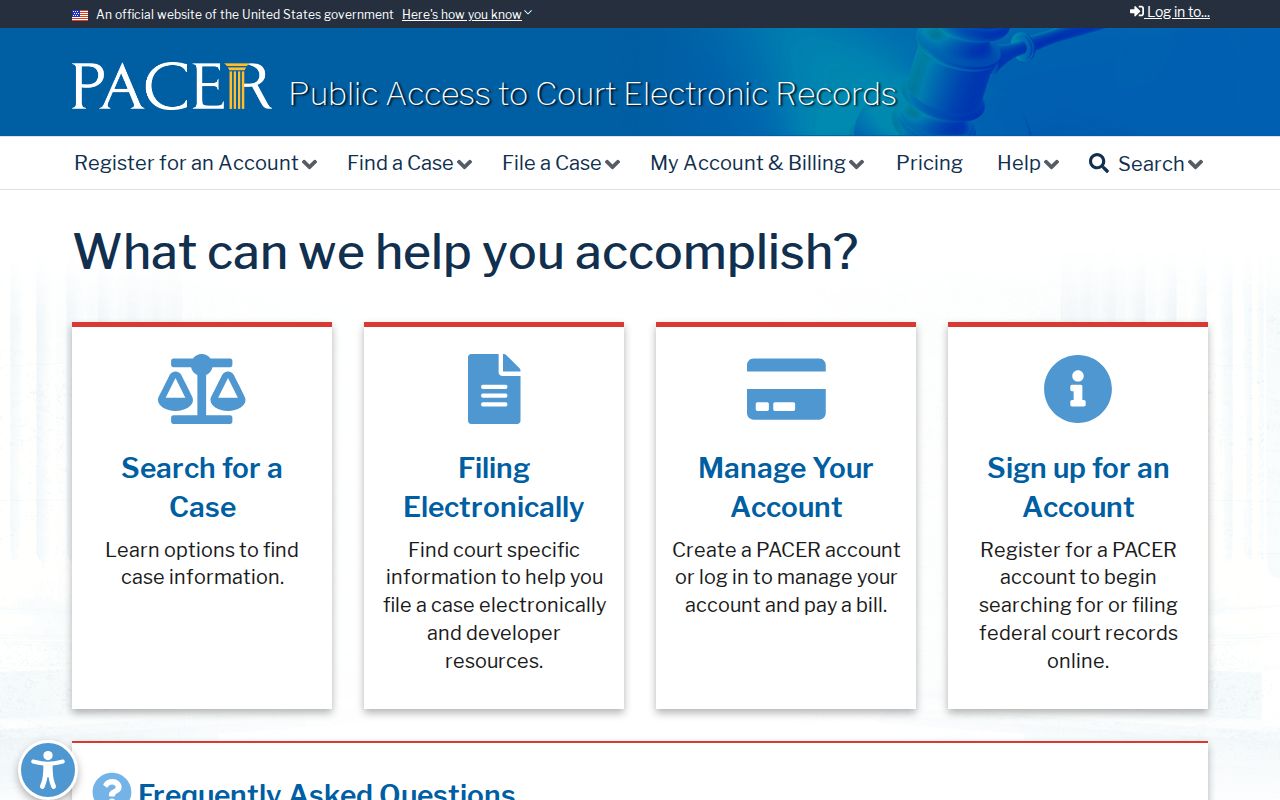
The PACER image represents a case-record route, not a nationwide previous residents directory. Confirm the court, case number, party role, and filing date before connecting a case to a property history.
The U.S. District Court for the Central District of California covers Orange County for federal trial matters. Its public court information should be checked alongside PACER when a federal record is relevant.
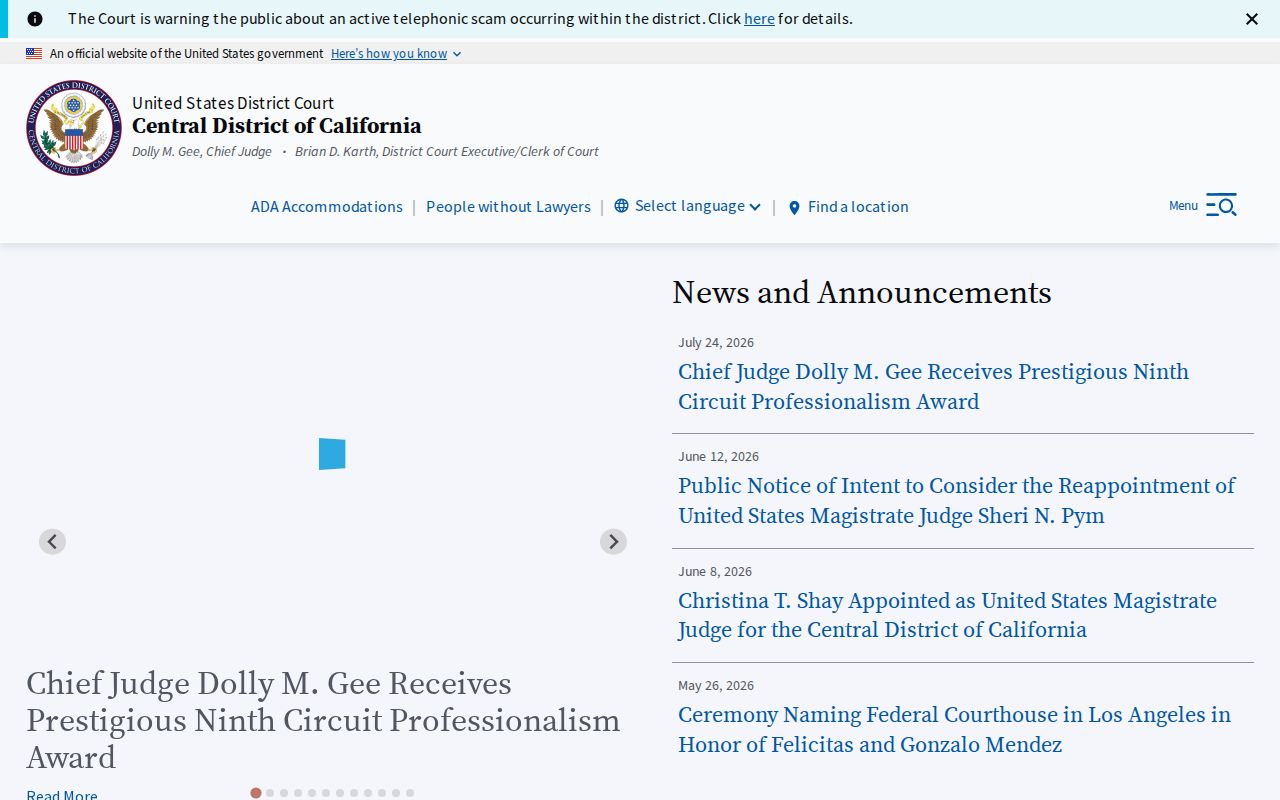
The court-site image reinforces the jurisdiction check. A federal docket can corroborate a dated event, but it does not replace the county deed chain or directory and census evidence.
Unclaimed Property: Not a Previous Residents Roll
The California State Controller's Unclaimed Property search is a cautious supplemental clue. It offers a free name-and-city search, identifies reported property held for an owner, and supplies a claim path. A listed address may be old, and the result does not establish current residence, occupancy, or ownership of a Fountain Valley parcel.
Use a match only when the name, city, date, and independent property or family-history evidence fit. Never turn an unclaimed-property listing into a present-day address claim. The official claim process is the correct next step for the person entitled to the property; a third party should not treat the listing as a substitute for a deed, probate filing, or certified vital record.
The official California State Controller Unclaimed Property search is the name-search route shown below. Its value in a house history is narrow: it can suggest a former name-and-city connection that needs independent corroboration.
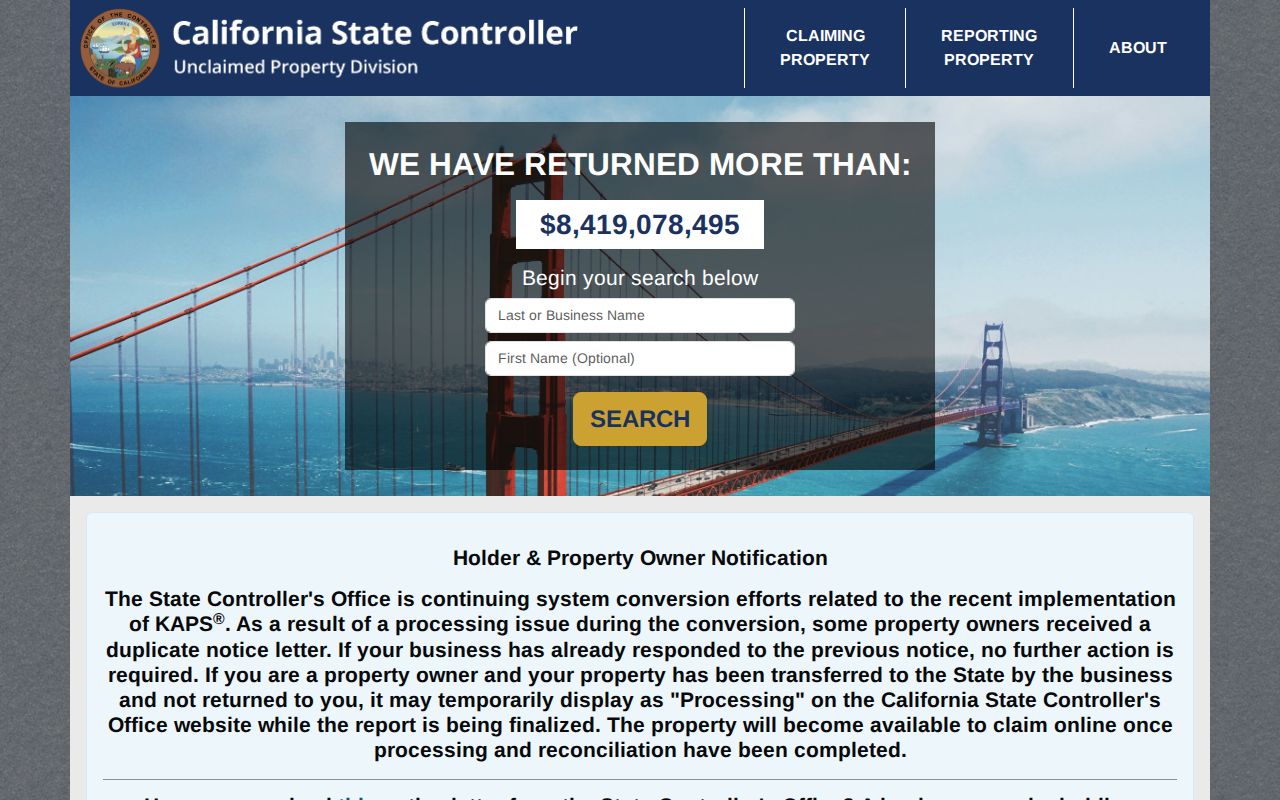
The unclaimed-property image is a reminder to label the result as a supplemental clue, not proof that a person lived at the subject house.
Orange County Property-Fraud Notices
Orange County highlighted property-fraud courtesy notices on May 14, 2026. The notice route is meant to alert owners when a real-property document has been recorded; verify the current enrollment and delivery mechanics through the Orange County Clerk-Recorder fraud-alert page. It is separate from the grantor-grantee search and does not create a previous residents list.
An official-looking solicitation can copy a real APN, deed date, or document detail from public records. Correct facts do not authenticate the sender. Compare any copy offer with the county's stated $1-per-page charge plus $1 certification per document or map, and use the official custodian when the record matters.
Lawful Fountain Valley Previous Residents Research
Previous residents research has legitimate uses in family history, a house history, estate work, genealogy, and personal curiosity. It does not authorize threats, surveillance, unwanted contact, or attempts to expose a protected person. California Penal Code §646.9 addresses stalking, and Code of Civil Procedure §527.6 provides a harassment restraining-order process. Records access never cancels those limits.
California's Safe at Home program gives qualifying survivors and other eligible participants a substitute mailing address and confidential mail-forwarding. The program does not erase every historical public record, so an old directory or deed may still exist even when a current address is protected. The Secretary of State Safe at Home page is the proper source for program rules.
Lawful personal use. Keep a Fountain Valley house-history trail tied to a documented parcel, a dated source, and a lawful purpose. Do not use a previous residents result to stalk, harass, intimidate, or harm a living person.
Label each conclusion by its source: deed owner, listed directory occupant, census household member, permit participant, probate party, or supplemental name clue. That discipline protects accuracy and keeps a past-resident question from becoming an unsupported claim about someone today.